
Emergency HVAC Cleaning Near Me: What Washington Heights Homeowners Should Do First
Most calls that come in as “emergency HVAC cleaning” aren’t emergencies at the duct level. They’re emergencies at the air handler, the coil, or the drain pan, and sending a duct crew out first just delays the fix that actually matters. If you’re standing in a Washington Heights apartment right now with a burning smell or a wet ceiling, the next 30 minutes are about triage, not vacuuming: shut the system down, find where the problem is coming from, and call from a room that doesn’t smell like smoke.
If you’d rather hand it to someone equipped for it, call (877) 792-7271. Otherwise, here’s the sequence we walk people through on the phone every week.
Is it a duct-side emergency or a mechanical-side emergency?
This is the first question, and getting it wrong is the most expensive mistake homeowners make. A duct-side emergency means contamination is sitting in the ductwork itself: debris, mold discharge, smoke residue, or post-flood silt. A mechanical-side emergency means the air handler’s components are failing: a frozen or fouled evaporator coil, a blower motor that’s overheating, or a drain pan that’s overflowing into the ceiling. The two problems require different people and different equipment, and a duct cleaning won’t fix a blower that’s grinding itself to death.
Quick signs of a duct-side issue
- Musty or moldy smell that gets stronger when the fan runs, and fades when it stops
- Visible dark dust puffing from supply registers right after the system kicks on
- Smoke residue or soot film on the grilles after a kitchen fire or a neighbor’s fire
- Recent water intrusion into ceilings or walls that ran through the duct runs
Quick signs of a mechanical-side issue
- Burning or hot-plastic smell concentrated at the air handler closet, not the vents
- Water staining or a drip trail on the ceiling near the unit or drain line
- Loud rattling, screeching, or short-cycling from the blower itself
- The system runs constantly but airflow is weak at every register
If it’s mechanical, shut the breaker off at the panel. That’s not a DIY repair anyone should attempt. Electrical components and refrigerant lines in an air handler are genuinely dangerous, and a trained technician needs to open that unit. If it’s duct-side, you’ve got more time, but you still want the system off until someone qualified looks at it.
What should you do before any technician arrives?
Three things, in this order: stop the air, contain the source, and document everything. This is the part homeowners control, and doing it well makes the difference between a straightforward cleaning and a re-contamination problem that comes back in a month.
- Shut the system down. Switch the thermostat to off, then kill power to the air handler at the breaker panel. Contamination that isn’t moving isn’t spreading. Smoke residue and mold spores travel through every branch line the fan touches.
- Isolate the returns if you can. In most Washington Heights apartments the return is a single large grille or a wall cavity, and closing it off with cardboard and painter’s tape limits how much debris gets pulled into the unit while you wait. Don’t seal supply registers; you want to leave those open so no pressure builds.
- Document with your phone. Photograph the vent openings, the stained ceiling, the air handler closet, and any visible debris or mold. Those photos serve two purposes: they help the contractor diagnose before arriving, and they’re the first thing your insurance adjuster will want to see.
One more thing: pull the filter and photograph it before you toss it. A filter loaded with soot or mold tells a technician a lot about what happened and how far contamination traveled.
Why Washington Heights pre-war buildings have their own contamination patterns
Washington Heights is full of buildings from the 1920s and 1930s, and the way those buildings were ducted, converted, and patched over the decades creates contamination problems you won’t see in a new-build. Shared risers run between floors, so what originates in one unit can move through the chase. Converted steam systems have been retrofit with forced-air or split systems in ways that leave old chases serving new equipment.
The practical consequence: a cleaning sequence that works fine in a suburban house can spread contamination through a Washington Heights building instead of removing it. That’s why the order of operations matters. Negative pressure needs to be established at the source before any brushing or agitation starts, and returns need to be isolated from the rest of the stack until containment is verified. Doing the visible cleaning first and the containment second just redistributes the mess.
We’ve also seen what happens after a water event in these buildings: the water finds the lowest point in a shared chase, so a leak on the fourth floor shows up in the ductwork on the second. That’s not a duct problem to vacuum away. It’s a moisture problem that needs source repair, drying, and then duct cleaning, in that order. Cleaning a wet duct is worse than leaving it alone. Water intrusion needs to be stopped and dried out before anyone runs a vacuum through the system, or you’re cleaning a surface that is going to re-contaminate as soon as the next humid day arrives.
For the full process of how a properly sequenced cleaning goes, see our page on air duct cleaning, which walks through source containment, HEPA extraction, and final verification in the order a pre-war building actually needs.
What equipment separates real emergency response from a shop-vac crew?
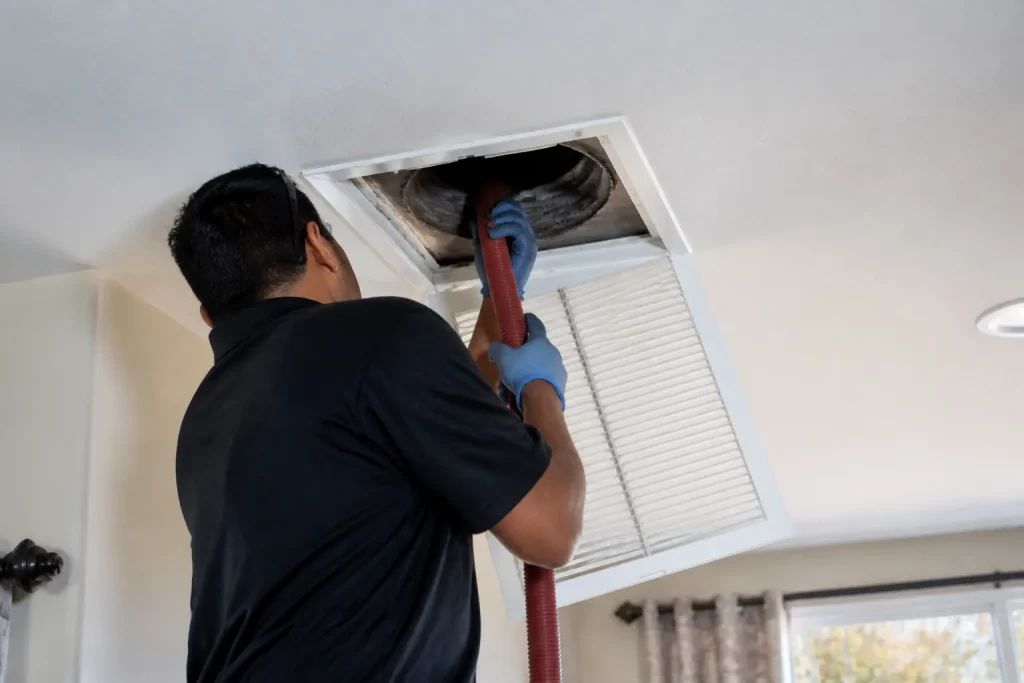
The difference comes down to containment and extraction. A shop-vac and a brush on a drill can knock loose debris, but without negative air pressure, that debris goes somewhere else: into the room, into the next branch line, into your neighbor’s return. A proper emergency response starts by pulling the system into negative pressure with HEPA-filtered extraction, then agitates and cleans under that containment so nothing escapes.
This is why we run Rotobrush and Nikro systems on the agitation and extraction side, paired with Abatement Technologies air filtration to hold negative pressure during active contamination events. Those are purpose-built professional machines, not repurposed equipment. During a mold or smoke event, the difference is measurable: HEPA extraction holds what’s already airborne, containment keeps the cleaning from spreading fresh contamination, and the work is verifiable by photos before and after rather than by a technician’s promise.
If the problem turns out to be mechanical, or if the duct runs have torn joints or a collapsed section, that needs to be fixed before any cleaning will hold. We handle both, and the full scope of that work lives on our HVAC cleaning page. Duct cleaning that runs before a torn joint is sealed is a temporary fix at best. If the source of re-contamination is still open, you’ve paid to clean a system that will be dirty again in a season. That’s where duct repair & sealing comes in: seal the breach, then clean.
What do you ask when you’re calling for same-day response?
This is the sequence that weeds out the companies that show up with a shop vac and a clipboard. Ask these five questions in order. A company that can answer all of them honestly can probably handle the scope. One that gets vague on any of them, or pushes you toward a low teaser price before they’ve even asked what’s wrong, isn’t the right call.
- “Is this a duct problem or a mechanical problem?” A capable company will ask you three or four diagnostic questions on the phone before giving you any price. If they start selling the job before asking what’s happening, keep calling.
- “What’s your containment process?” You’re listening for HEPA-filtered extraction and negative air pressure, not “we’ll put plastic down.”
- “Are you cleaning the whole system, or just the visible ducts?” A proper job includes the air handler, the coil, the plenum, and every branch line, not just the runs you can reach from the grille.
- “Is the price one figure for the whole system, or per vent?” The answer you want is one flat price agreed before work starts. Per-vent pricing is how a modest quote becomes a big invoice once the technician is on site.
- “Will I see before-and-after photos of my own system?” Not stock photos. Your ducts, photographed before and after.
Washington Heights homeowners ask us these every week, and we’d rather answer them on the phone than have someone sign up blind. The other thing to ask: what if the cleaning uncovers a mechanical problem? A company with real diagnostic range will tell you to hold the cleaning and fix the mechanical issue first. That’s not a lost job; that’s an honest one.
When to call a pro (and when it really is urgent)
Call a professional right away if you smell smoke or burning, see visible mold discharge around a vent or on the air handler, have water that ran through a duct run, or notice soot on the registers. These are cases where DIY cleaning is dangerous at worst and wasted effort at best. For routine annual or seasonal cleaning, you can schedule a normal appointment. The urgency in an HVAC emergency is getting a trained eye on the system fast, not trying to scrub it yourself.
While you’re at it, if you haven’t had the dryer vent looked at in years, that’s a separate fire-risk issue many duct cleaners treat as an afterthought. We offer it as its own service. Both the duct system and the dryer vent deserve a real look; they’re different problems with different safety stakes.
Related services in Washington Heights
If the emergency points toward routine maintenance rather than a same-day fix, the best place to start is our Air Duct Cleaning Washington Heights page, which covers the full scope of what we do for residential and light-commercial buildings in the neighborhood. If you’re sorting out whether cleaning, repair, or a mechanical fix comes first, a free estimate is the fastest way to get an answer.
What happens when you call
- 1
A real person answersNo phone trees – you reach a local pro.
- 2
You get an upfront price rangeHonest numbers before anyone is dispatched.
- 3
A background-checked tech heads outLicensed & insured, dispatched right away.
- 4
You approve before work beginsNothing starts until you say go.
The Bottom Line
The first 30 minutes of an HVAC emergency are about triage, not cleaning. Identify whether the problem is duct-side or mechanical, shut the system down, isolate the returns, and document everything with photos. Then call a company that can explain its containment process and give you one flat price for the whole system before anyone arrives. Washington Heights pre-war buildings demand a sequenced approach, because shared risers and retrofitted equipment mean contamination travels further than you’d expect. When you’re ready to hand it off, we’re here. Our technicians have up to 13 years of experience and work with professional-grade Rotobrush, Nikro, and Abatement Technologies equipment.
If you’re in Washington Heights and need help, Air Duct Cleaning Washington Heights offers free estimates. Call (877) 792-7271. We answer 24/7. Fast dispatch from 7am to 7pm, Sunday through Friday.
Frequently Asked Questions
The smell tells you most of it. A musty or moldy odor that rises when the fan runs and fades when it stops usually points to the ducts. A burning or hot-plastic smell concentrated at the air handler closet, water staining near the unit, or a blower that’s screaming points to a mechanical problem. Shut the breaker off either way, and call us at (877) 792-7271 to talk it through. Estimates are free.
Yes, but only with containment in place. Active contamination needs negative air pressure and HEPA extraction before any agitation starts, or the cleaning spreads the problem. We run Abatement Technologies air filtration and Nikro extraction specifically for that reason. Call (877) 792-7271 for a free estimate on what your system needs.
It depends on the building, not on a calendar. Pre-war buildings with shared risers, pets, smokers, or recent water damage need cleaning more often than a sealed newer apartment. The honest answer is inspect first, clean when the inspection justifies it. We won’t sell you a cleaning your system doesn’t need. Call (877) 792-7271 and we’ll walk you through what applies to your unit.
Because they’re quoting a lighter job than the one you need. Low teaser prices usually mean a shop vac, no containment, and per-vent pricing that grows once the technician is on site. A real estimate covers the whole system, not just the visible ducts, and it’s one flat price agreed before work starts. Call (877) 792-7271 for a straight answer and a free estimate.
Written by the team at Air Duct Cleaning Washington Heights.
Need Air Duct Cleaning Help?
Call Air Duct Cleaning Washington Heights - the local pro we connect you with is licensed and insured, here with fast help in Washington Heights.
(877) 792-7271