
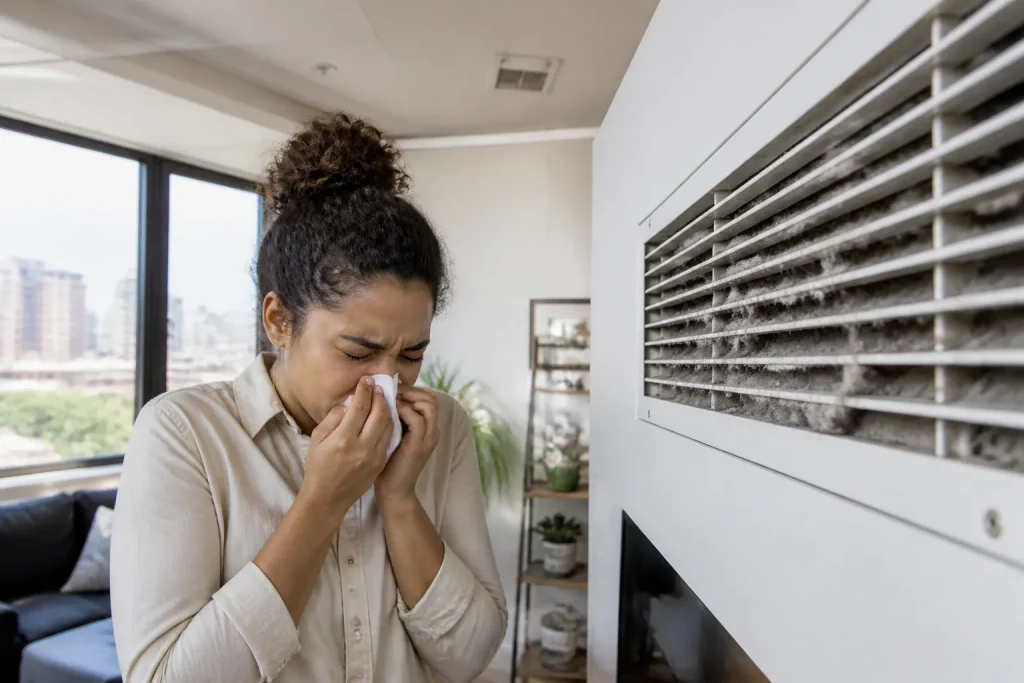

Top Signs You Need Air Duct Cleaning Service – Don’t Ignore These
Dust settling on the coffee table an hour after you wipe it is the symptom most people search for, and it’s one of the least reliable. In our experience it’s often a filter that isn’t seating properly or a leak in the return, and no amount of vacuuming the ducts will fix either one. Real duct contamination announces itself differently. Here are the signals that hold up to a closer look, and the ones that point somewhere else entirely.
If you’d rather not spend a weekend chasing symptoms with a flashlight, call (877) 792-7271. We answer 24/7, and estimates are free.
Which “signs” of dirty ducts are actually filter or leak problems?
Visible dust is the weakest evidence in the whole checklist. A filter that has slipped out of its channel, a filter rack that doesn’t seal, or a return duct pulled loose at a joint will pull unfiltered air straight into the system, and it lands on your furniture looking exactly like duct contamination. The difference is that cleaning the ducts fixes it for about a week.
What separates a duct problem from a filter problem:
- The dust comes back evenly across the whole home. Fine, gray dust on every surface points to filtration or air movement. Heavy dust in one room, right under a register, points to a break in that branch line.
- The filter is loaded on one side only. An uneven loading pattern usually means air is bypassing the filter instead of passing through it.
- You can see the seam. A disconnected joint in an accessible run of duct in a basement or closet is a repair, not a cleaning.
- Airflow is weak at some registers and strong at others. That’s a distribution issue, and duct repair and sealing is where the fix lives.
One thing worth doing before you call anyone: run the system with the blower on and hold a tissue near the supply registers. If it flutters weakly at a register that used to push hard, you’ve got a supply problem, not just dirty air. A technician with up to 13 years of experience can pressure-test the system and tell you which one you’re looking at. Professional-grade equipment, residential pricing means we can check both without guessing.
What does a musty smell from the vents actually tell you?
A musty smell that appears only when the air handler runs, and fades when it stops, points to growth on the evaporator coil or on the interior liner of the air handler cabinet. A smell that’s strongest right at one register points to debris or moisture inside that branch of duct. The location of the smell is the diagnostic tool, and it’s the single most useful thing you can tell a technician on the phone.
Musty is also the symptom most likely to be misdiagnosed. A few common causes, in rough order of how often we encounter them:
- A wet coil or a clogged condensate drain. Standing water in the drain pan breeds growth. Cleaning ducts while the pan is still wet just re-seeds the system.
- Duct liner that stayed damp. Insulated flex duct that got wet during a humidity spike can hold odor in the liner itself.
- Debris in a low run of duct. Construction dust and drywall fines settle in the low spots and pick up moisture over time.
What actually resolves odor is finding the moisture source and eliminating it, then cleaning and, where appropriate, sanitizing the surfaces that were affected. That’s why our service menu includes both cleaning and air quality sanitizing backed by Honeywell and Aprilaire filtration products. From dirty ducts to cleaner air is a process, and the process starts with the source. If the source is a wet coil, duct cleaning alone won’t get you there, and a technician who tells you otherwise is guessing.
Why do Washington Heights apartments show symptoms other homes don’t?
Older Washington Heights buildings have a specific history with ductwork. Many were built with steam heat and later converted to forced air. The original piping is sometimes capped in place or left behind, and the conversion work left soot, pipe scale, and metal debris inside the new duct runs. Decades of that fine soot sitting in a supply trunk is a legitimate cleaning trigger, not a cosmetic one, and it looks like a gray film on the register grille that won’t wipe off.
The other pattern is renovation debris. In a prewar apartment building, a gut renovation two floors up can send drywall dust, sawdust, and fiberglass particles into the shared return path. Some of that settles in your ductwork even if you never touched a wall. If your symptoms started within weeks of a neighbor’s renovation, that timing is worth mentioning when you call.
If you’re seeing that gray film on the grilles and want to know what it’s from, our team handles air duct cleaning Washington Heights and can tell you on site whether it’s soot, sheetrock dust, or ordinary household buildup. Each one is a different job.
How useful is a particle count test compared with looking at the vent?
A particle counter reading taken near a supply register tells you more about your ducts than any visual inspection of the grille. A meter that reads airborne particles by size can show you whether the system is adding particles to the room when the blower runs, and that’s the difference between a cosmetic concern and a real one.
Here’s how the comparison plays out in practice:
- Visual inspection of a vent cover tells you what’s stuck to the grille. That’s mostly what’s on the surface, and surfaces are the easy part.
- A particle count near a supply register with the blower on tells you what the system is delivering into the room. If the count climbs when the blower starts, the system is a source.
- A before-and-after reading gives you a way to confirm the work was done. We take before-and-after photos of the ducts themselves for the same reason.
We use Rotobrush and Nikro systems that agitate and extract material from the duct walls rather than blasting it loose, and we contain it at the source. We clean the system, not just the visible parts.
When should you NOT clean your ducts?
Sometimes cleaning is the wrong call, and it’s worth knowing the two biggest reasons before anyone opens a register in your apartment. The first is damaged duct liner. If the interior insulation is friable, flaking, or separating from the duct wall, cleaning agitation can break more of it loose and put it into your air. That liner needs repair or replacement first.
The second is insulation that may contain asbestos. In pre-1980 buildings, duct wrap and insulation should be tested before it’s disturbed. Cleaning an unsealed asbestos-containing duct surface can make the air quality problem worse, not better. We don’t touch those materials until they’ve been tested and handled appropriately, and no reputable technician should.
Other situations where cleaning gets you little:
- Duct runs that are mostly short, straight, and clean. A system with wide open sheet metal and no liner may not need cleaning at all.
- A persistent smell with no visible contamination. That’s usually a coil, drain, or liner problem, and cleaning is treating the symptom.
- Unsealed ducts in an unconditioned space. Clean all you want; if the ducts leak, dust comes right back in. Duct sealing that holds is what makes the cleaning last.
Our duct repair & sealing work exists for exactly these cases. We’d rather tell you that you don’t need a cleaning than take your money for one that won’t hold.
When should you call a professional?
If you’ve checked the filter and it’s seated correctly, if the smell tracks with the blower, or if you’ve got a visible dust pattern pointing at one branch of duct, it’s time to have someone look at the actual system. A technician can run a pressure check, look at the coil and drain, and tell you which of the symptoms you’re seeing belong to which problem.
Two things worth asking any company before you book, in Washington Heights or anywhere else: what equipment they use, and whether they can show you the inside of the ducts in photos before and after. An Abatement Technologies filtration unit in the equipment lineup signals true containment-grade capability, and that’s a fair question to put to anyone.
Related services in Washington Heights: Air Duct Cleaning Washington Heights for the full system, HVAC cleaning when the coil and air handler are the issue, and dedicated dryer vent cleaning as its own safety service, since a blocked dryer vent is a fire hazard and not something to fold into a general cleaning visit.
The Bottom Line
Dust on the furniture is the loudest sign and the least trustworthy. Trust the ones the system can’t fake: a musty smell that tracks with the blower, dust concentrated at one register, soot or renovation debris in older Washington Heights buildings, or a particle count that climbs when the air handler kicks on. And know the cases where cleaning is the wrong answer, like damaged duct liner or untested insulation in a prewar building. Cleaning the wrong system just moves the problem around.
If you’re in Washington Heights and need help, Air Duct Cleaning Washington Heights offers free estimates. Call (877) 792-7271. We answer 24/7. Fast dispatch from 7am to 7pm, Sunday through Friday.
Written by the team at Air Duct Cleaning Washington Heights.
Frequently Asked Questions
For most homes, every three to five years is a reasonable starting point, and some systems go much longer. The honest answer is that it depends on the system: a home with pets, a recent renovation, or a building with a history of conversion debris may need it sooner, while a clean, well-sealed system with a good filter can go years past that. Rather than follow a calendar, watch for the specific symptoms above. Call (877) 792-7271 for an exact quote on your system. Estimates are free.
Cheap quotes usually mean one of two things: a truck-mounted vacuum run through the registers for twenty minutes with no agitation of the duct walls, or a coupon price that grows once the technician is on site. Professional cleaning means agitating the duct surfaces and containing what comes out, which takes equipment like Rotobrush or Nikro extraction units. Ask what equipment will be used and whether you’ll get before-and-after photos of your own ducts. Call (877) 792-7271 for an exact quote. Estimates are free.
Ask for before-and-after photos of the inside of the ducts, not just the vent covers. Photos of the duct interior are the most direct evidence, and a courteous technician will take them without being asked. A particle counter reading before and after is useful too. If a company can’t show you the inside of your ducts before and after, that’s your answer. Call (877) 792-7271 to schedule a look at your system. Estimates are free.
Not always. A musty smell from the vents often points to microbial growth on the evaporator coil or inside the air handler liner, and sometimes to a clogged condensate drain holding water. Cleaning the ducts without addressing the moisture source will bring the smell back. The fix is finding and eliminating the source, then cleaning and sanitizing what it affected. Call (877) 792-7271 and describe where the smell is strongest. Estimates are free.
Need Air Duct Cleaning Help?
Call Air Duct Cleaning Washington Heights - the local pro we connect you with is licensed and insured, here with fast help in Washington Heights.
(877) 792-7271